| Visual effects: Distortions (psychedelic) |
This article attempts to break down the distortions and visual alterations contained within the psychedelic experience into simple, easy to understand titles, descriptions and levelling systems. This will be done without depending on metaphors, analogy's or personal trip reports. The article starts off with descriptions of the simpler effects and works its way up towards more complex experiences as it progresses.
Contents
Colour shifting
Colour shifting can be described as the colours of various objects (particularly brightly coloured or out of place objects) becoming subject to an effect that shifts and changes its appearance through a repeated cycling of colours in a strange and fluid motion across its surface. For example, moss on a rock could physically shift from green to red to blue to any other colour and then back to green again in a very short space of time.
Image examples
-
Flowers by Chelsea Morgan
-
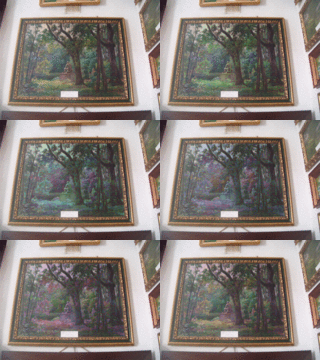
Painting by Anonymous
-
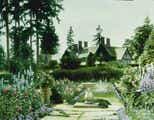
Garden painting by Anonymous
-
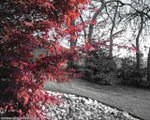
Japanese Maple by Anonymous
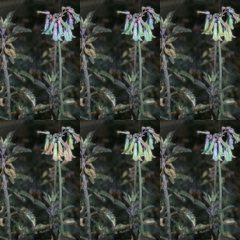


Visual drifting


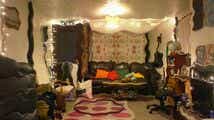
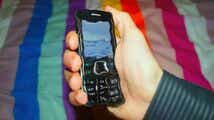
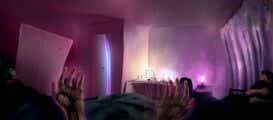
Visual drifting can be described as the experience of objects and scenery appearing to become progressively warped and morphed across the visual field. These alterations gradually increase as a person stares, but are non-permanent and will reset to their normal appearance once a person double takes.
This effect is capable of manifesting itself across 4 different levels of visual intensity. These are defined below as:
- Peripheral - The most basic form of visual drifting can be described as a 'wiggling' of straight lines within the external environment. This occurs exclusively within one's peripheral vision and cannot be directly looked at.
- Direct - At this level, visual drifting does not necessarily increase in its intensity but can now be directly looked at within a person's central line of sight. This partially alters the appearance and form of shapes, objects and sceneries within the external environment, causing them to subtly drift, bend and morph.
- Distinct - At this level, visual drifting becomes powerful enough to drastically alter and transform the shape of specific objects within one's external environment. This is often to the point where they can become unrecognisable in comparison to their original form.
- All-encompassing - At the highest level of visual drifting, the intensity becomes powerful enough to distort not just specific objects beyond recognition, but every single point of a person's vision and the entirety of the external environment in its whole.
The particular style of this visual effect depends on the specific continuously changing direction, speed and rhythm of the distortion. This results in a small variety of different manifestations which are defined and listed below.
Morphing
Morphing can be described as an effect of visual drifting which is completely disorganized and spontaneous in both its rhythm and direction. It results in objects and scenery appearing to gradually change, morph and warp in their size, shape, configuration and general appearance.
Breathing
Breathing can be described as an effect of visual drifting which makes objects and scenery appear to be steadily contracting inwards and expanding outwards in a consistent rhythm, in a similar fashion to the lungs of a living organism.
Melting
Melting can be described as effect of visual drifting which results in objects and scenery appearing to completely or partially melt. It begins at lower doses as a gradual liquidization of objects, which causes them to subtly droop, wobble, and lose their structural integrity. This gradually increases until it becomes impossible to ignore as the lines, textures, and colour between solid objects begins to melt into one another in an extremely fluid style.

Flowing
Flowing can be described as an effect of visual drifting which seems to occur almost exclusively on textures (particularly if they are highly detailed, complex, or rough textures). This results in them flowing like a river in a seamless, looped animation and is particularly common on wood grain.
Image examples
-
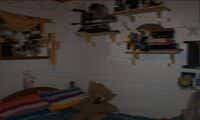
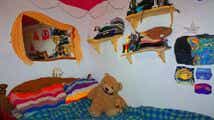
Wibbly Wobbly bedroom by Chelsea Morgan
-

White wolf drinking water by Anonymous
-
Living room by Chelsea Morgan
-
Flowing wood grain by Chelsea Morgan
-
Mobile phone by Chelsea Morgan
-
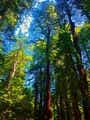
Redwoods by CountRoloff
-
Visual drifting by Anonymous
-

The starry night by Vincent Van Gogh



Variations
- Intricate vs. Simplistic – In terms of its complexity, drifting will either alter the external environment in a way that spreads out in many different complex directions and results in the original piece of sensory input becoming completely unrecognisable in appearance. If not, it will be simplistic in nature and stick to simple warping, wiggling and bending even at high dosages.
- Slow vs. Fast – Drifting can manifest itself as something that progresses in its visual alterations at a fast and sudden rate or gradually and slowly as a person stares into it.
- Smooth vs. Jittery – In terms of its motion, drifting can manifest itself as a smooth, fluid and flawless movement or jittery with an extremely slow frame rate that moves in sudden and partial transitions.
- Static vs. Fleeting – In terms of its permanence, drifting will either maintain its position until the tripper double takes or will be extremely fleeting in its nature, meaning that it will reset almost as soon as a person tries to look directly at it.
- Realistic vs. Unrealistic – Drifting can either look convincing in its appearance or extremely cartoon-like and unrealistic.
Depth Perception Distortions
Depth perception distortions can be defined as the experience of both extreme and subtle distortions in depth perception. This is where the depths and layers of the scenery in front of you can become exaggerated, skewed or completely rearranged in their organization. A classic example of this could be the swapping of layers in a scenery. This is where objects in the background come into the foreground and objects in the foreground get pushed into the background.
Another example of skewed depth perception can be described as a complete loss of it. This occurs when the different sections of a scenery unify into a flat 2-Dimensional image regardless of their actual distance from the observer.
Tracers
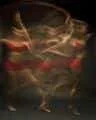
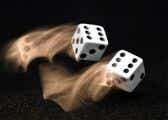
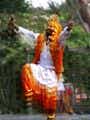
Tracers can be described as the experience of trails being left behind moving objects such as people, birds or cars in a manner that is similar to those found in long exposure photographs. They can manifest as exactly the same colour of the moving object which is producing it or can sometimes be a randomly selected colour of their own.
A near consistent way to reproduce this visual effect is to move one's hand in front of their face or throw an object under the influence of psychedelics.
Tracers can be broken down into 4 basic levels of visual intensity. These are defined below as:
- Transparent - The most basic form of tracer can be described as an almost completely transparent after image which disappears quickly and drags shortly behind moving objects.
- Translucent - At this level, tracers increase in their length to become at least roughly half as long as the distance across the visual field which the object it is following has moved. In terms of clarity, the tracers shift from barely visible to distinct and partially transparent in colour.
- Opaque - At this level, tracers become completely solid in appearance and opaque in their colour with distinct and sharp edges to their shape which draw a clear contrast between the tracer itself and the background behind it. They become equal in length to the distance across the visual field which the object it is following has moved in and can remain in the air for up to several seconds.
- All-encompassing - The highest level occurs at the point when a person’s visual field has become so sensitive to the creation of tracers that the entirety of it smudges and blurs into an all-encompassing tracer at the slightest movement of the eye. This can make it extremely difficult to see unless the eyes are kept still and remains in the air indefinitely or until one moves their eyes and double takes.
Image examples
-
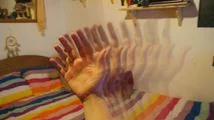
Tracers by Chelsea Morgan
-
Motion by Bill Wadman
-
Tumbling Dice by Rosendahl
-
Shamanic tracers by Anonymous

Symmetrical texture repetition
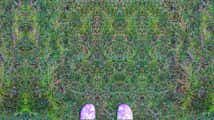
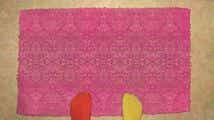
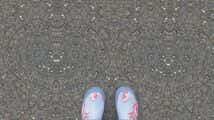
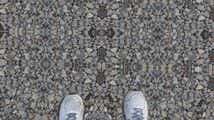
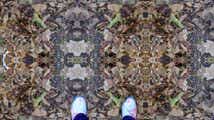
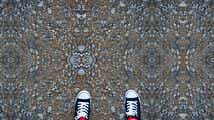
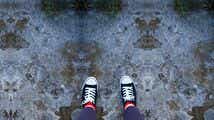
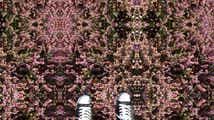
Symmetrical texture repetition can be described as a distinct visual alteration which specifically manifests itself through rough textures such as grass, carpets, asphalt, tarmac, towels, bathroom rugs, gravel, general bracken, dense vegetation, fallen leaves, tree bark and more.
It can be described as the texture becoming mirrored repeatedly over its surface in an extremely intricate and symmetrical fashion that is consistent across itself. This maintains the same level of detail no matter how closely one attempts to look at the distortion.
As these repeating textures are generated, they begin to give rise to a huge array of abstract forms, imagery and patterns embedded within and across the symmetry and are often complemented by the simultaneous experience of enhanced pattern recognition.
Image examples
-
Grass by Chelsea Morgan
-
Bathroom rug by Chelsea Morgan
-
Asphalt by Chelsea Morgan
-
Stones by Chelsea Morgan
-
Leaves by Chelsea Morgan
-
Gravel by Chelsea Morgan
-
Ice by Chelsea Morgan
-
Flower bush by Chelsea Morgan
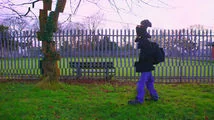
Scenery Slicing
Scenery slicing can be described as an effect which only occurs spontaneously and rarely sustains itself for more than several seconds. It makes the visual field appear as if it has been cut into separate slices with some sort of razor blade in a remarkably clean fashion. These separate slices then proceed to drift slowly away from their original position before disappearing and resetting to normality. The organisation of these slices show great variety and can be as simple as three separate sections or as complex as multiple intricate slices of a moving interlocking spiral or any other possible design.
Image examples
-
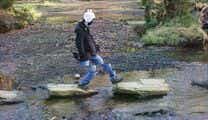
Finn jumping rocks by Chelsea Morgan
-
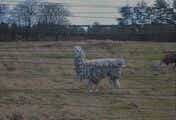
"Llama" by Chelsea Morgan
-
A walk in the park by Chelsea Morgan
-
Dissociative scenery slicing by Chelsea Morgan