Psychedelic |

Psychedelics are a class of hallucinogens named so because the term is derived from the Greek words ψυχή (psyche, "mind") and δηλείν (delein, "to manifest"). The term means "mind-manifesting" with the implication being that psychedelics can access and develop unused potentials of the human mind.[1] In modern times, psychedelic drugs used in the context of religious, shamanic, or spiritual settings are often referred to as entheogens.[2]
Contents
Method of action


Psychedelics act on serotonin receptors (also referred to as 5-HT receptors) via the way in which they act as full or partial agonists through their structural similarity to the serotonin molecule. DMT, for example, works by simply fitting into and activating serotonin receptors. It has a higher affinity than serotonin itself for the receptors, therefore preventing serotonin from binding to the receptors by competing with it.
While the method of action behind psychedelics is not fully understood, serotonergic psychedelics are known to show affinities for various 5-HT receptors in different ways and levels and may be classified by their activity at different 5-HT sub-sites, such as 5-HT1A, 5-HT1B, 5-HT2A, etc. Many serotonergic psychedelics (such as the tryptamines) have very strong structural similarities to serotonin itself which partially explains the affinity for certain 5-HT sites. It is almost unanimously agreed that serotonergic psychedelics produce their effects by acting as strong partial agonists at the 5-HT2A receptors, with a few exceptions acting as full agonists (such as 25I-NBOMe).
Subjective effects
The effects listed below are based upon the subjective effects index and personal experiences of PsychonautWiki contributors. The listed effects will rarely (if ever) occur all at once, but heavier dosages will increase the chances and are more likely to induce a full range of effects.
Visual effects 
-
Enhancements
-
Distortions
-
Geometry
-
Hallucinatory states
- Alterations in perspective
- Autonomous entities
- External hallucinations
- Scenarios and plots
- Settings, sceneries, and landscapes
- Shadow people
- Transformations
Internal hallucinations
In comparison to the other classes of hallucinogen, this effect is very common at moderate to heavy dosages. It can be comprehensively described through its variations as lucid in believability, interactive in style, new experiences in content, autonomous in controllability, geometry-based in style and almost exclusively of a personal, religious, spiritual, science-fiction, fantasy, surreal, nonsensical or transcendental nature in their overall theme.
Cognitive effects 
-
Enhancements
-
Suppressions
-
Novel states
-
Spiritual states
Physical effects 
-
Enhancements
-
Novel effects
-
Uncomfortable effects
Auditory effects 
Multisensory effects 
Pharmacological classes

The classical psychedelics are all classed as serotonergic in nature. This means that they structurally mimic the endogenous neurotransmitter known as serotonin, the neurotransmitter responsible for feelings of well-being and mood regulation.[6] The diagram to the right shows the structural similarities and differences between the differing classes of psychedelics and the serotonin neurotransmitter. The three classes (phenethylamines, lysergamides and tryptamines) all contain the same chemical rings (which have been labelled).
- A represents the benzene ring, which all three classes contain.
- B represents the pyrrole ring in both tryptamines and lysergamides.
- A and B together form the indole ring.
- C (cyclohexane) and D are only contained in the lysergamides, possibly contributing to their potency.
Examples
Specific compounds
-
Lysergamides
-
Tryptamines
- α-MT
- 4-AcO-DiPT
- Psilacetin (4-AcO-DMT)
- 4-AcO-MET
- Ethocin (4-HO-DET)
- 4-HO-MET (Metocin)
- Psilocin (4-HO-DMT)
- 4-HO-MiPT
- Psilocybin (4-PO-DMT)
- Bufotenin (5-HO-DMT)
- 5-MeO-DiBF
- 5-MeO-DiPT
- 5-MeO-DMT
- 5-MeO-DALT
- 5-MeO-MiPT
- Diisopropyltryptamine (DiPT)
- Dimethyltryptamine (DMT)
- Dipropyltryptamine (DPT)
- Ibogaine
-
Phenethylamines
-
β-Carbolines
-
Others
- Benzydamine
- Elemicin
- Myristicin
- Mirtazapine

Responsible use
The information below describes and explains various concepts regarding the responsible use of psychedelic compounds. These should be read over and considered before one decides whether or not it will be safe to trip.
Setting 
- Choosing an appropriate and safe place for a person to undergo the effects of a substance is extremely important and plays a huge factor in determining the outcome of an experience. The best place for an inexperienced user is a familiar, safe and indoor environment that is completely devoid and free of certain factors which can cause a direct negative influence.
-
- Ensure that one is completely free of responsibilities during the experience and the day after as the simplest of tasks will become incredibly difficult and sometimes stressful under the influence of certain intoxicating substances. One should be relaxing and remaining comfortable, not performing chores. This includes driving and operating heavy machinery for obvious reasons.
-
- Avoid people who are irrelevant as they should not be present throughout the duration of the experience. This includes parents who are sleeping in the same house and close friends who are anything but extremely trustworthy and understanding. The mere presence of people can be very anxiety-inducing for many individuals.
-
- Avoid potentially dangerous, loud, unfamiliar, cluttered, and/or public environments. The more cluttered and messy one's environment is the more disorganized and negative one's state of mind can be.
-
- Avoid general bad vibes of any sort. This may seem obvious, but do not watch scary or unpleasant films and do not listen to unpleasant music. If bad vibes are encompassing the experience, they can easily be escaped by quickly changing your environment. For example, if one is sitting down with the light off, stand up and put the lights on, change the music or move to a different area and any negative thoughts will immediately reset to base level.
- Once a person has become familiar with their substance of choice and aware of their own limits, it becomes entirely down to them as an individual when it comes to whether or not they would be comfortable tripping in a more recreational environment such as nature, social gatherings, parties, raves, etc. The inexperienced, however, should always seek out a safe, comfortable room at home or a friend's house. This should be with privacy, relaxing music, comfortable seating, a vomit bucket (in case of nausea) and readily available food/water.
State of mind
-
One of the most important factors to consider as an inexperienced user is one's current state of mind. Many substances exponentially enhance a person's current state of mind, emotions and general perspective on the world which is a process that can go in either a positive and euphoric direction or a negative, terrifying and anxiety ridden direction. It is because of this that many substances should not be used by the inexperienced during stressful or negative periods of life and users should be fully aware of the ways in which hallucinogens and other drugs, particularly psychedelics, consistently force a person to face and deal with their personal introspective problems that all human beings deal with.
It has often been recommended that those with severe pre-existing mental conditions (especially individuals with psychotic illnesses like schizophrenia) should not ingest these substances due to the way they strongly increase one's current state of mind and emotions as well as cause delusions and hallucinations.
Throughout the experience itself the person needs to let go and allow the effects to take charge. One should be taking the metaphorical passenger seat and never trying to control any part of the experience. It is extremely important that people simply relax and take things as they come. The user must understand that the act of tripping is often ineffable and incomprehensible at high enough dosages, meaning that an acceptance of not being able to understand the full scope of what is happening should be present at all times. One should be embracing the fact that their thought processes, although more insightful in places, will be inherently impaired along with motor control, conversational skills and general functioning. The user should be sure to view these effects as normal and not feel self-conscious or insecure about them within the presence of others.
Physical state
- The current condition that one's body is in is as important as one's mood when going into a trip. If one feels tired, sick or injured, these sensations will manifest as amplified versions of the same conditions during the trip which, when combined with the possible body load, may easily ruin one's mood and therefore the rest of the experience. Instead of tripping during a stressful, tired, sick or injured time in your life, one should wait for a more suitable opportunity. This will drastically lower one's chances of having a bad experience.
Trip sitters 
-
Main article: Trip sitter If one is using hallucinogens, a sober, responsible trip sitter is strongly recommended to be present throughout a trip by an inexperienced individual or group with an unfamiliar substance. It is this person’s responsibility to assist the individual or group by maintaining a rational and responsible frame of mind. This should be done by simply watching over the trippers and calmly reassuring them if they experience any anxiety or stress, whilst also preventing them from coming to any harm. There is an obvious correlation between the name trip sitter and babysitter; this is because at many times, trip sitting can be like babysitting and it is definitely a responsibility that must be taken just as seriously.
A good trip sitter needs to be sure of a number of things throughout the experience. They should remain (mostly) sober and should be able to empathize with the group members’ situation through personal experiences with the substance/similar substances or at least a considerable amount of research on their effects. Trip sitters should understand that when a person is tripping, they might not be able to communicate as they usually do. Also, their balance and spatial judgement may be off so assistance in performing physical tasks such as keeping hydrated can greatly reduce anxiety. The trip sitter can contribute to the conversation, but should also remember to leave them to explore the experience without too much external influence.
Once a person is familiar with the experience, it becomes down to them whether or not they feel comfortable enough to trip without a sitter.
Anchors 
-
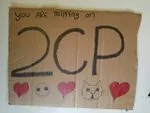 "You are tripping on 2C-P" - This sign is an example of an anchor which can be used to keep one grounded during ego death.
An anchor, in the context of hallucinogen usage, can be defined as an activity or physical object which keeps one grounded during heavy suppression and distortion of a person's sense of time, space, language, ego and short/long-term memory. At higher dosages, this can result in extreme disorientation and confusion. Anchors are often used to counteract this and maintain one's concept of the current situation as it is within reality. Examples of anchors include:
-
- Familiar and uplifting music. An example of this includes our community good vibes portal. However, the creation of a playlist that is comprised of music one associates with being happy is highly recommended.
-
- An extremely personal and ingrained image or object
-
- Continuous repetition of a meaningful word or motto as a mantra
-
- Writing an easily readable reminder onto a large piece of paper and placing it close within one's visual field throughout the experience. Common reminders include the name of the substance along with its dosage and phrases such as "You are tripping on LSD." The same principle can be used to write reminders on one's hand or other visible body parts.
-
- An item of clothing or an accessory which is only worn during and therefore associated with the act of tripping.

Aborting trips 
-
Hallucinogens have the potential to become overwhelming and push trippers into paranoid/dreadful moods if the tripper is inexperienced or in an inappropriate setting.
If one decides that they want the trip to end, benzodiazepines and other sedatives such as some antipsychotics can be considered as an analogous "eject button" of a downhill-headed or extensively long trip. They are very useful tools in preventing panic attacks, paranoia, and possible traumatic experiences. If these are available, be sure to keep them at hand as they are extremely effective tools for mitigating a hallucinogenic crisis. Independent research should always be done to ensure that a combination of two or more substances is safe before consumption.
See also
References
- ↑ A. Weil, W. Rosen. (1993), From Chocolate To Morphine:Everything You Need To Know About Mind-Altering Drugs.New York, Houghton Mifflin Company. p. 93
- ↑ Dictionary - Entheogen | http://dictionary.reference.com/browse/entheogen
- ↑ What your brain looks like on magic mushrooms | http://www.telegraph.co.uk/news/science/science-news/11207979/What-your-brain-looks-like-on-magic-mushrooms.html
- ↑ LSD's impact on the brain revealed in groundbreaking images | https://www.theguardian.com/science/2016/apr/11/lsd-impact-brain-revealed-groundbreaking-images
- ↑ Psychedelics: entering a new age of addiction therapy | http://www.pharmaceutical-journal.com/news-and-analysis/features/psychedelics-entering-a-new-age-of-addiction-therapy/20066899.article#fn_link_1
- ↑ How to increase serotonin in the human brain without drugs|journal = Rev. Psychiatr. Neurosci.|volume=32|issue=6|pages = 394–99|year = 2007| http://www.ncbi.nlm.nih.gov/pmc/articles/PMC2077351/


