Responsible drug use |
Responsible drug use (also known as harm reduction) in the context of psychonautics can be defined as the act of doing adequate research and taking the appropriate precautions to ensure that one is ingesting drugs in a manner that is comfortable, safe, and unlikely to result in a bad experience. This article is dedicated to providing a comprehensive instructional guide on the variety of factors one should consider before experimenting with psychoactive substances in a safe and responsible manner. The first part of this article emphasizes harm reduction tactics for all drug-induced experiences while the bottom half focuses exclusively on hallucinogens.
Responsible drug use index 
| Dosage | Classification · Choosing dosages · Measuring dosages · Eyeballing · Milligram scales · Volumetric liquid dosing · Allergy testing · Routes of administration |
| Harm reduction | Reagent testing kits · Dangerous combinations · Festival and rave safety · Safe injection · Tapering · Recovery position |
| Hallucinogens | Setting · State of mind · Physical state · Trip sitters · Anchors · Bad trips · Aborting trips |
| Specific drugs | Research chemicals · Synthetic cannabinoids · Stimulants · Depressants · Deliriants · Dissociatives · Psychedelics |
| Health | Addiction · Withdrawal · Drug overdoses · Panic attacks · Serotonin syndrome · Overheating · Dehydration · Seizures · Health consequences of drug use |
| Resources | Safe infection sites · Needle distribution programs · Naloxone programs · Pill testing programs and laboratory analysis · Crack pipe kits · Drug consumption facilities · Lab test results |
Dosage 
-
Main article: Dosage Within the context of psychonautic or recreational substance usage, it is important to understand dosages and to pay close attention to them with extreme caution. Administering the wrong dosage of a drug can lead to negative experiences such as extreme anxiety, uncomfortable physical side effects, a bad psychedelic trip, hospitalization, or (in extreme cases) death. Taking too low of a dose can often make people feel uncomfortable and frustrated.
-
Choosing dosage
Main article: Choosing dosage It is important that one avoid dosages which one is uncomfortable or unfamiliar with. An inexperienced user should always start at very low dosages with the goal of working their way up in small increments as they feel comfortable doing so. This should be done by slightly increasing the dosage with each separate experience and never taking great leaps into the unknown.
This minimizes the risk of an accidental negative experience enormously; it is important to remember that everybody reacts differently to every substance depending on factors such as their own personal tolerance, neurophysiology, body weight, metabolism, and personal sensitivity. Another factor to consider is drug purity which differs between batches of product.
For information on the appropriate dosage for any substance, research should be done using a combination of PsychonautWiki, Erowid, Tripsit, Wikipedia and Google.
-
Allergy testing
Some people, especially those with health issues, have adverse reactions to drugs such as allergic reactions, uncomfortable physical or cognitive effects, or over-sensitivity.[1] The best way to prevent this is to perform an allergy test, which is simply dosing a minuscule amount of the drug (1/4 of a regular dose) and waiting several hours to a few days.
-
Eyeballing
Main article: Eyeballing Eyeballing is strongly discouraged. Eyeballing is a highly inaccurate method of measuring substances which involves looking at a substance and making a rough guess of the weight. Since there is not much difference between 10mg and 30mg visually, it can result in one taking too much of a substance.[2]
There are numerous forms of eyeballing methods including using micro scoops and the graph paper method, both of which result in inaccurate dosing.
Users should not trust a vendor's word that their product weighs a certain amount as it is not unheard of for vendors to accidentally or intentionally give out the wrong amount of a product, resulting in overdoses for some users.[3]
It is especially dangerous to eyeball substances that have extremely low doses (under 10mg).
-
Milligram scales
Main article: Milligram scales When buying chemicals in powdered form, it is strongly recommended that one invest in a reliable and accurate digital milligram scale to ensure that they are ingesting a safe and recommended dosage.
To achieve the most accurate measurement, the scale should only be used on a completely flat surface away from vibrations, wind, and drafts. Low batteries can also affect the scale's accuracy, so one should occasionally replace them.[4]
There are a huge variety of different scales available online through various sites. To choose a quality scale, users should read the reviews before buying and come to their own personal decision. Users should ideally choose a scale that has a 0.001g readability. When using a scale that has 0.005 gram readability (5mg), the weight will be off by 5mg in either direction, meaning that if one measures 20mg of a substance, the results will be between 15-25mg.
Milligram scales under $1000 cannot accurately weigh out doses below at least 50mg and are highly inaccurate under 10-15mg. For potent drugs, please use volumetric liquid dosing.
Most milligram scales are more accurate in higher ranges (5 - 15 grams) than the lower ranges. Therefore, it is better to weigh one's drug while the 10 gram weight is on the scale.
-
Volumetric liquid dosing
Volumetric liquid dosing is the process of dissolving a compound in a liquid to make it easier to measure. In the interest of harm reduction, it is essential to prepare certain compounds which are too potent to measure with traditional weighing scales within a liquid solution. Most standard milligram scales cannot accurately weigh out doses below 10-15mg.[5]Main article: Volumetric liquid dosing This technique makes it possible to use a cheap $30 scale and still measure accurately to only a few milligrams.[6] Please see this article for more information about this form of measurement.
There is a volumetric dosing calculator located here which will calculate the amount of drug and solvent needed as well as the concentration.


Reagent testing kits 
-
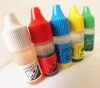
When purchasing psychoactive compounds, one should always be certain precisely which chemical they are in possession of because it may very well differ from what it was advertised/sold as. If this is the case, it could potentially result in a negative experience or even death. Investing in Marquis, Mecke, Mandelin, or Ehrlich reagent tests will provide the ability to test chemicals at home without needing to submit them to a laboratory.
One can look up and compare their results with the data provided online to verify the content of the chemicals one has. Test kitting has become particularly important since Chinese chemical manufacturers became involved in the research chemical scene, sometimes selling impure and/or mislabelled products.
There are detailed instructions on how to use these testing kits available here and displayed within the infographics below.
-


Dangerous combinations 
- Although many drugs are perfectly safe by themselves, there are many combinations which can be extremely dangerous or even fatal. This should always be considered when combining multiple psychoactive substances and adequate independent research must be performed in order to determine the safety of the combination if one wishes to avoid potential physical harm, hospitalization or even death. Many prescription medications interact negatively with commonly used recreational drugs. The most common cause of drug-related deaths is the combination of depressants (such as opiates, benzodiazepines, or alcohol) with other depressants.
-
.
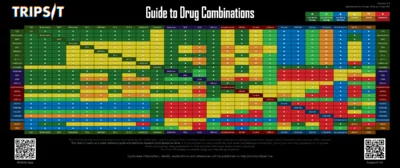 The image above is a useful chart which can be used as a quick reference tool for determining the safety of common combinations. For more information please visit its original creators at TripSit.me

Effects 
-
Main article: Subjective effect index It is important to know in advance on a detailed and comprehensive level the duration, pharmacology, subjective effects and potential adverse effects which the substance or combination of substances are likely to induce. There are many online resources to use for education and reference regarding this aspect of drug usage. If a dedicated breakdown for your specific substance of choice has been written, be sure to find and read it within the psychoactive substance index.
For further research on the effects of any substance that one may be considering, a combination of www.Erowid.org, en.Wikipedia.org and Google.com can be used. It may also help to read relevant anecdotal trip reports found here on PsychonautWiki or elsewhere across the Internet.
If one knows the exact effects of the drug in advance, then they will know what to expect. This is something which significantly reduces the chances of a negative experience by a huge margin through the prevention of unexpected circumstances.
Addiction 
-
If a person is to use a substance responsibly, the frequency in which they use should be monitored closely. Many stimulants and depressants are extremely physically and/or psychologically addictive. Careful consideration and research should be put into the regular use of any of these substances.
Although many of the classical psychedelics are physically benign no matter how frequently they are used and come with a built-in tolerance which prevents using them more than once a week, this is not the case with all hallucinogens. Dissociatives, deliriants and certain psychedelics may come with potential adverse health effects that need to be individually researched before use. Any hallucinogen can cause problems with a person's psychological health if overused. Keep in mind that substance usage becomes an addiction once the negative aspects start to outweigh the positive aspects, but one continues to use regardless.
Hallucinogens
This advice below is exclusively for hallucinogens such as psychedelics, dissociatives, and deliriants.
Setting 
- Choosing an appropriate and safe place for a person to undergo the effects of a substance is extremely important and plays a huge factor in determining the outcome of an experience. The best place for an inexperienced user is a familiar, safe and indoor environment that is completely devoid and free of certain factors which can cause a direct negative influence.
-
- Ensure that one is completely free of responsibilities during the experience and the day after as the simplest of tasks will become incredibly difficult and sometimes stressful under the influence of certain intoxicating substances. One should be relaxing and remaining comfortable, not performing chores. This includes driving and operating heavy machinery for obvious reasons.
-
- Avoid people who are irrelevant as they should not be present throughout the duration of the experience. This includes parents who are sleeping in the same house and close friends who are anything but extremely trustworthy and understanding. The mere presence of people can be very anxiety-inducing for many individuals.
-
- Avoid potentially dangerous, loud, unfamiliar, cluttered, and/or public environments. The more cluttered and messy one's environment is the more disorganized and negative one's state of mind can be.
-
- Avoid general bad vibes of any sort. This may seem obvious, but do not watch scary or unpleasant films and do not listen to unpleasant music. If bad vibes are encompassing the experience, they can easily be escaped by quickly changing your environment. For example, if one is sitting down with the light off, stand up and put the lights on, change the music or move to a different area and any negative thoughts will immediately reset to base level.
- Once a person has become familiar with their substance of choice and aware of their own limits, it becomes entirely down to them as an individual when it comes to whether or not they would be comfortable tripping in a more recreational environment such as nature, social gatherings, parties, raves, etc. The inexperienced, however, should always seek out a safe, comfortable room at home or a friend's house. This should be with privacy, relaxing music, comfortable seating, a vomit bucket (in case of nausea) and readily available food/water.
State of mind 
-
One of the most important factors to consider as an inexperienced user is one's current state of mind. Many substances exponentially enhance a person's current state of mind, emotions and general perspective on the world which is a process that can go in either a positive and euphoric direction or a negative, terrifying and anxiety ridden direction. It is because of this that many substances should not be used by the inexperienced during stressful or negative periods of life and users should be fully aware of the ways in which hallucinogens and other drugs, particularly psychedelics, consistently force a person to face and deal with their personal introspective problems that all human beings deal with.
It has often been recommended that those with severe pre-existing mental conditions (especially individuals with psychotic illnesses like schizophrenia) should not ingest these substances due to the way they strongly increase one's current state of mind and emotions as well as cause delusions and hallucinations.
Throughout the experience itself the person needs to let go and allow the effects to take charge. One should be taking the metaphorical passenger seat and never trying to control any part of the experience. It is extremely important that people simply relax and take things as they come. The user must understand that the act of tripping is often ineffable and incomprehensible at high enough dosages, meaning that an acceptance of not being able to understand the full scope of what is happening should be present at all times. One should be embracing the fact that their thought processes, although more insightful in places, will be inherently impaired along with motor control, conversational skills and general functioning. The user should be sure to view these effects as normal and not feel self-conscious or insecure about them within the presence of others.
Physical state 
- The current condition that one's body is in is as important as one's mood when going into a trip. If one feels tired, sick or injured, these sensations will manifest as amplified versions of the same conditions during the trip which, when combined with the possible body load, may easily ruin one's mood and therefore the rest of the experience. Instead of tripping during a stressful, tired, sick or injured time in your life, one should wait for a more suitable opportunity. This will drastically lower one's chances of having a bad experience.
Trip sitters 
-
Main article: Trip sitter If one is using hallucinogens, a sober, responsible trip sitter is strongly recommended to be present throughout a trip by an inexperienced individual or group with an unfamiliar substance. It is this person’s responsibility to assist the individual or group by maintaining a rational and responsible frame of mind. This should be done by simply watching over the trippers and calmly reassuring them if they experience any anxiety or stress, whilst also preventing them from coming to any harm. There is an obvious correlation between the name trip sitter and babysitter; this is because at many times, trip sitting can be like babysitting and it is definitely a responsibility that must be taken just as seriously.
A good trip sitter needs to be sure of a number of things throughout the experience. They should remain (mostly) sober and should be able to empathize with the group members’ situation through personal experiences with the substance/similar substances or at least a considerable amount of research on their effects. Trip sitters should understand that when a person is tripping, they might not be able to communicate as they usually do. Also, their balance and spatial judgement may be off so assistance in performing physical tasks such as keeping hydrated can greatly reduce anxiety. The trip sitter can contribute to the conversation, but should also remember to leave them to explore the experience without too much external influence.
Once a person is familiar with the experience, it becomes down to them whether or not they feel comfortable enough to trip without a sitter.
Anchors 
-
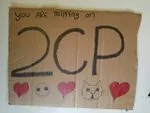 "You are tripping on 2C-P" - This sign is an example of an anchor which can be used to keep one grounded during ego death.
An anchor, in the context of hallucinogen usage, can be defined as an activity or physical object which keeps one grounded during heavy suppression and distortion of a person's sense of time, space, language, ego and short/long-term memory. At higher dosages, this can result in extreme disorientation and confusion. Anchors are often used to counteract this and maintain one's concept of the current situation as it is within reality. Examples of anchors include:
-
- Familiar and uplifting music. An example of this includes our community good vibes portal. However, the creation of a playlist that is comprised of music one associates with being happy is highly recommended.
-
- An extremely personal and ingrained image or object
-
- Continuous repetition of a meaningful word or motto as a mantra
-
- Writing an easily readable reminder onto a large piece of paper and placing it close within one's visual field throughout the experience. Common reminders include the name of the substance along with its dosage and phrases such as "You are tripping on LSD." The same principle can be used to write reminders on one's hand or other visible body parts.
-
- An item of clothing or an accessory which is only worn during and therefore associated with the act of tripping.

Aborting trips 
-
Hallucinogens have the potential to become overwhelming and push trippers into paranoid/dreadful moods if the tripper is inexperienced or in an inappropriate setting.
If one decides that they want the trip to end, benzodiazepines and other sedatives such as some antipsychotics can be considered as an analogous "eject button" of a downhill-headed or extensively long trip. They are very useful tools in preventing panic attacks, paranoia, and possible traumatic experiences. If these are available, be sure to keep them at hand as they are extremely effective tools for mitigating a hallucinogenic crisis. Independent research should always be done to ensure that a combination of two or more substances is safe before consumption.
See also
External links
- The Importance of Measured Doses (Erowid)
- Psychoactive Vaults: Dose (Erowid)
- Research Chemical FAQ (Erowid)
- Safer Partying (Trip Project)
- Guide to Drug Combinations (TripSit)
- Fundamentals of Responsible Psychoactive Use (Erowid)
References
- ↑ Erowid Psychoactive Vaults: Dose | https://www.erowid.org/psychoactives/dose/dose.shtml
- ↑ How big is a milligram? (Ask Erowid) | https://www.erowid.org/ask/ask.php?ID=2282
- ↑ The Importance of Measured Doses by Fire Erowid & Spoon | https://www.erowid.org/psychoactives/basics/basics_measuring1.shtml
- ↑ American Weigh Scales, Inc Gemini-20 User Manual | http://www.americanweigh.com/pdf/manuals/gemini-20_manual.pdf
- ↑ 3-MeO-PCP (Tripsit) | https://wiki.tripsit.me/wiki/3-MeO-PCP
- ↑ Liquid Measurement Technique by Zam (Erowid) | https://www.erowid.org/psychoactives/dose/dose_info1.shtml
- Responsible drug use


