External hallucinations |
 |
This article requires proofreading. As such, it likely contains incorrect grammar, spelling, and punctuation. |

External hallucinations can be described as the experience of perceiving imagined visual concepts and occurrences which display themselves seamlessly into the external environment as if they were actually happening. They can be broken down into 4 basic levels:
- Erratic hallucinations - The lowest level of external hallucination generally consists of movement within the peripheral vision, and/or ill-defined, fleeting hallucinations which disappear once a person double takes.
- Vaguely defined hallucinations - At this level the hallucinations are visible within one's direct line of sight but are not fully defined in their appearance. This means that although visible, they do not look completely detailed and are often blurry or semi-translucent with little if any colour.
- Partially defined hallucinations - At this level the hallucinations increase into a high enough amount of detail and vividness to extend beyond transparent, colourless or blurry manifestations. However, they still remain unconvincing and do not quite live up to the detail of completely realistic and convincing hallucinations.
- Fully defined hallucinations - As the vividness and intensity increases, the content eventually becomes comprised of completely realistic hallucinations which do not necessarily disappear once a person double takes. These are generally considered by those who have experienced them to be capable of a completely convincing and photo-realistic appearance.
There are certain factors that directly alter both the likelihood of external hallucinations manifesting themselves and the level of detail which they are rendered in. The more unfamiliar with the external environment one is, the more this effect will be likely to manifest itself. Cluttered areas also tend to produce more external hallucinations. As far as lighting goes, either a dark or dim room is optimum. Darkness produces much more hallucinations but the light present in a dim room will result in less (though more detailed) hallucinations.
The content within this component can be further broken down into four distinct subcomponents which are described and documented below.
Contents
Autonomous entities
_by_Luke_Brown.jpg/)
Autonomous entities can be described as the visual experience of perceived contact with beings which appear to be sentient and autonomous in their behaviour. This is a shared subjective effect component that can manifest as a result of both external and internal hallucinations.
Autonomous entities seem to act as the inhabitants of a perceived independent reality. Although many entities seem largely unaware of one's presence, generally speaking they tend to be expectant of the person's sudden appearance into their realm and often choose to interact with them in various ways. The behaviour of a typical entity can vary wildly and seems to depend heavily on one's current emotional state of mind. For example, whilst many will act as loving, kind intelligences, teachers or healers, in certain contexts, they are equally capable of acting as indifferent, uncaring or even as malicious tormentors.
Entities can take any form but subconscious archetypes are present and commonly include humans, friends, family, loved ones, strangers, oneself, shadow people, bodiless super intelligent humanoids, aliens, elves, animals, giant spheres, insectoids, beings of light, anthropomorphic beings, plants, conscious inanimate objects, fictional characters, cartoons, robotic machines, gods, demigods, goddesses, bio-mechanical intelligences, hooded figures, demons, indescribable monstrosities, spirits, angels, shamans, ghosts, souls, ancestors, fantastical or mythological beasts, glitch creatures and more.
Personality types
Regardless of appearance, there are distinctly different personality types of entities which one may encounter, each of which represent a particular subsection of one's own consciousness and can be identified primarily through their personality, but also sometimes their appearance. These are broken down into 3 separate categories below.
- Representations of the self - The simplest personality type of an entity can be described as a mirror of one's own personality. It can take any visible form but clearly adopts an identical vocabulary and set of mannerisms to one's own consciousness when conversed with.
- Representations of specific concepts or people - This category of entity is by far the most varied type in terms of its visual form and immediately perceivable personality. It can be identified as a simulated sentient representation of any internally stored concept and adopts an appropriate personality to fit this to an amazing degree of accurate detail. For example, this specific concept could include people you have met throughout your life, specific fictional characters or symbolic representations of concepts such as abstract ideas, emotions or key parts of one's own personality.
- Representations of the subconscious - This category of entity personality type can take any visible form but is felt to be a supposedly conscious controller behind the continuous generation of the details regarding one's current experience. This is controlled simultaneously along side of the management of one's current own perspective, personality and internally stored model of reality. When conversed with, this category of entity posses abilities which allow them to directly alter and manipulate one's current experience and heal past traumas. They usually adopt an attitude which wants to teach or guide the person and will operate under the assumption that they know what is best for them.
Communication styles
Autonomous entities can communicate with a person via a combination of normal spoken word, telepathy, geometry-based visual linguistics, mathematics and morphing coloured structures of different textures which are innately readable as representations of specific concepts.
In terms of the conversational topics which autonomous entities choose to discuss, they will usually convey insights regarding the overcoming of personal issues or problems within the one's life. However, they can also speak with cryptic or nonsensical messages which seem to have no clear or obvious meaning behind them.
When communicated with through spoken word, the level of coherency in which these entities can communicate with is highly variable but can be broken down into 4 distinct levels. These are listed below as:
- Silence - This level can be defined as a complete unresponsiveness from the side of the entity and an incapability of speech despite their obvious presence within the hallucination.
- Partially defined incoherent speech - This level can be defined as audible linguistic conversational responses and noises which sound like words but do not contain any real content or meaning beyond a vague sense of emotional intent.
- Fully defined incoherent speech - This level can be defined as audible linguistic conversational responses and noises which contain fully defined and understandable words but often lack grammatical structure or an overall sense of general coherency.
- Partially defined coherent speech - this level can be defined as audible linguistic conversational responses and noises which contain fully defined and understandable words with a partially defined grammatical structure and general coherency which conveys its point on a level which may not always be fully understandable but is still capable of conveying a general point.
- Fully defined coherent speech - This level can be defined as audible linguistic conversational responses which contain understandable words and a fully defined grammatical sentence structures or an overall sense of general coherency which conveys its point on a level that is on par with that of own intellect.
Image examples
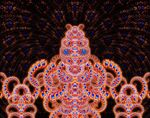
Id-Aliunde by Beau Deeley
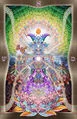
Baphomet by Luke Brown

Sophia by Alex Grey
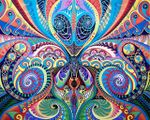
Untitled by Anonymous
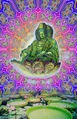
Maitreya by Luke Brown
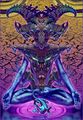
Jerrestrial detail by Luke Brown
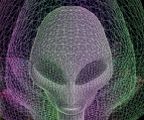
Tryptamine Alien by James L Kent
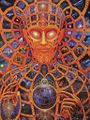
Cosmic Christ by Alex Grey

Namaste 3D by Luke Brown
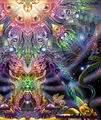
Alpha Centauri by Luke Brown
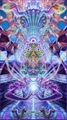
Apotheosis by Luke Brown
_by_Luke_Brown.webp)
Namaste (Trifoliata Mystica) by Luke Brown


Settings, sceneries, and landscapes
Settings, sceneries, and landscapes can be described as a shared subjective effect component that manifests as a result of both external and internal hallucinations.
These can be defined as the experience of the setting in which the plot of an external or internal hallucination occurs. These settings manifest with infinite variety.
When explored, the geography of these settings are capable of rendering themselves as static and coherent in organization but will usually manifest as a non-linear, nonsensical and continuously ever-changing layout which does not necessarily obey the rules of everyday physics. In terms of the chosen locations, appearance and style of these settings, they seem to be selected at random and are often entirely new and previously unseen locations. They do, however, play a heavy emphasis on replicating and combining real life locations stored within the person's memories, especially those which are prominent within one's life and daily routine. Aside from this they common archetypes include:
Planetary systems, galaxies, quasars, jungles, rain forests, deserts, ice-scapes, cities, natural environments, caves, space habitats, vast structures, civilizations, technological utopias, ruins, machinescapes, historical settings, rooms and other indoor environments, neurons, DNA, atoms, molecules, mitochondria, incomprehensible geometric landscapes and more.
Alterations in perspective
Alterations in perspective can be described as a shared subjective effect component that manifests as a result of both external and internal hallucinations. This experience can be defined as an alteration in terms of the perspective in which a hallucination is perceived through. In just the same way as literary plots, these can be experienced through four alternate vantage points which are described and listed below:
- 1st person - This is the most common form of perspective and can be described as the perfectly normal experience of perceiving the scenario from the perspective of one's everyday self and body.
- 2nd person - This can be described as the experience of perceiving the hallucination from the perspective of an external source of consciousness such as another person, an animal or an inanimate object.
- 3rd person - This is essentially an out-of-body experience and can be described as perceiving the hallucination from a perspective which is floating above, below, behind, or in front of one's physical body.
- 4th person - This the least common form of perspective and can be described as the experience of perceiving the hallucination from the perspective of multiple or even infinite vantage points simultaneously.
Scenarios and plots
Scenarios and plots are a shared subjective effect component that manifests as a result of both external and internal hallucinations.
The components which comprise hallucinatory states (autonomous entities, alterations in perspective, and settings, sceneries, and landscapes) are randomly shuffled and spliced into plots and scenarios. These may be positive or negative to experience and are difficult to define in a comprehensive manner in much the same way that one cannot predict the plot of literature and films.
They can, however, be broken down into basic occurrences which generally entail visiting a setting which often contains interactive autonomous entities. Alongside of these, completely unpredictable plot devices and events force the person to become involved within the specific scenario of the particular trip.
These scenarios and plots can be linear and logical with events that occur in a rational sequence which leads onto other events through cause and effect. However, they are equally likely to present themselves as completely nonsensical and incoherent. The plot of these scenarios will often result in spontaneous events which are capable of ending, starting and changing between each other repeatedly in quick succession. The plots can present as new experiences that are unlike anything experienced within the real world, old experiences such as accurate memory replays or a combination of the two.
Hallucinatory plots and scenarios usually feel as if they are being experienced in real-time. When 20 seconds has passed within the hallucination, the same amount of time will have passed in the real world. At other points, however, time distortions occur, resulting in plots and scenarios that can feel as if they last days, weeks, months, years, or infinitely long periods of time.
Shadow people

Shadow people are a common hallucination for humans to have. They usually appear as a result of sleep deprivation, psychoactive substancess, or hypnagogic states. During this experience, the subject perceives a patch of shadow in their peripheral vision to be a living figure. This can be either animal-like or humanoid in appearance. This hallucination is often accompanied with a feeling of intense paranoia and anxiety.
The visual hallucinations are initially fleeting images always out of the corner of the eyes. As time progresses, however, the hallucinations may appear in full view and one will be able to look directly at them. The bodies of the shadow people are usually entirely black with few features. They sometimes appear to have faces and are able to move or change shape.
These hallucinations are often perceived as being malicious due to intense paranoia and anxiety that often occur simultaneously. Tactile hallucinations, feelings of convincing physical sensations that are not actually occurring within reality, may occur. Auditory hallucinations may also manifest themselves, causing one to perceive that the shadow people are talking to them.
Image examples


Variations
- Lucid vs. Delirious - Hallucinatory states can maintain a consistent level of awareness throughout them regarding the fact that none of these events are really happening and that the current situation is simply a result of drug-induced hallucination. In contrast to this, hallucinations can also become completely believable no matter how nonsensical they may be in exactly the same way that we do not have any problem accepting absurd and non-linear plots within our dreams.
- Interactive vs. Fixed – Hallucinatory states can either present themselves as completely separate in a manner that is similar to watching a video play out in front of one's field of vision or they can be completely interactive. For example, conversing with autonomous entities or interacting with imagined objects in a fashion similar to lucid dreaming is entirely possible.
- New experiences vs. Memory replays – In terms of their subject matter, hallucinations can either be entirely new experiences or they can follow themes of normal everyday concepts and a replaying of specific memories.
- Controllable vs. Autonomous – Imagery and hallucinations can be partially to completely controllable. This can be described as the content of their appearance always seeming to perfectly follow and fit the general topic and subject matter of one's current thought stream with varying levels of partial to absolute control. In contrast, autonomous hallucinations are completely spontaneous in their subject matter and entirely uncontrollable.
- Geometry-based vs. Solid – Hallucinations can be comprised of condensed psychedelic geometry or they can appear as made from realistic materials.
Psychoactive substances
Compounds within our psychoactive substance index which may cause this effect include:
Experience reports
Anecdotal reports which describe this effect within our experience index include:
- Experience:2.5g Syrian rue + 6g Mimosa Hostilis - Becoming God (my second experience with unity)
- Experience:20mg (insufflated) - permanent all-encompassing states of unity and interconnectedness
- Experience:20mg - A profound sense of oneness
- Experience:20mg - I looked up and saw an angry god-like figure made of clouds glaring down at me
- Experience:20x Extract - a tall humanoid figure wearing a white cloak
- Experience:225ug LSD + 9g cubensis - Galactic Melt and the Meverse
- Experience:25mg DMT - Your wall can't save you
- Experience:2mg 25C-NBOMe - Experimental trip to test personal limits of NBOMes
- Experience:3.5g psilocybe cubensis - Relinquishing of Material Chains/Fear and Desolation
- Experience:300µg - Togetherness and the Silent Dusk
- Experience:337mg DMT fumurate - A Day With DMT
- Experience:35mg 2C-P - Asymmetrical Terror and the Geometric Sea
- Experience:4-FA + 5HTP: Irresponsible & unexpected psychedelic
- Experience:4.5g - The Grand Introduction to Beauty and Fear
- Experience:40mg + Syrian rue (3g) - My triumphant return
- Experience:450(Seeds)-Talking to Ghosts
- Experience:4x 200ug tabs - You do not need to understand
- Experience:50mg (approx.)/ Marijuana - Geometric Angels
- Experience:550mg-My First Time on DPH
- Experience:700mg - Joining the 700 club
- Experience:700mg - To the dextroverse.
- Experience:Becoming a god with my boyfriend
- Experience:Diphenhydramine
- Experience:Meditation with cannabis - terminated ego loss
- Experience:My DOB Nightmare
- Experience:Results of Experiment by Isopropanol
- Experience:Unknown Dosages: 1 psilocin chocolate, 1 hit LSD; Lawing the Mown
- Experience:Unknown dosage - Ego death and becoming one with a singular entity
- Experience:Unknown dosage / 3 tabs - Ego death and a total break through in the snow
See also
- Proofread
- Visual
- Hallucinatory
- Effect


