Datura |

Datura is known to cause dangerous and extremely unpleasant experiences.
Please use responsible use practices when trying this drug and always have a trip sitter.
| Datura | |||||||||||||||||||||
|---|---|---|---|---|---|---|---|---|---|---|---|---|---|---|---|---|---|---|---|---|---|
| Chemical Nomenclature | |||||||||||||||||||||
| Common names | Datura, Jimson Weed | ||||||||||||||||||||
| Substitutive name | Angel's Trumpets, Devil's Apple, Thorn Apple, Stinkweed, Devil's Weed, Moonflower | ||||||||||||||||||||
| Class Membership | |||||||||||||||||||||
| Psychoactive class | Deliriant | ||||||||||||||||||||
| Chemical class | Tropane alkaloid | ||||||||||||||||||||
| Routes of Administration | |||||||||||||||||||||
|
|
|||||||||||||||||||||

| Summary sheet: Datura |
Datura is a genus of flowering plants which is classed as a powerful deliriant drug containing tropane alkaloids such as scopolamine, hyoscyamine, and atropine, primarily in their seeds and flowers.
The plants precise and natural distribution seem to be throughout most of the temperate and tropical regions of the globe, owing to its extensive cultivation and naturalization. There are a total of nine different species in the Datura genus, but the two most well-known species are Datura inoxia and Datura strammonium. Both have been used in a shamanic context for religious purposes on most continents since before recorded history throughout the ancient Americas, Europe and India.
Chemistry
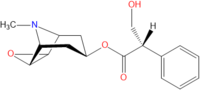
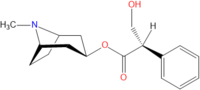
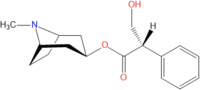
Chemically, the principal psychoactive constituents of all datura plants are tropane alkaloids such as scopolamine, hyoscyamine, and atropine, primarily in their seeds and flowers. These three constituents of datura are structurally analogous.
The molecules contain a substituted tropane ring, a seven-membered ring with a N-methylated nitrogen bridge between R1 and R5. Scopolamine additionally has an oxygen bonded to R6 and R7 of this bicyclic structure to form a three membered oxirane ring. These tropane alkaloids also contain a propionic acid chain, CH3CH2COOH, which is substituted at R2 with an aromatic phenyl ring and at R3 with a hydroxyl group OH-. The propionic acid chain is linked at R1 through an oxygen atom to R3 of the substituted tropane ring to form an ether.
These compounds are secondary metabolites synthesized naturally by various plants. The ratio of these compounds in datura plants is greatly varied depending on location, growing conditions, etc. The datura genus contains other chemical constituents, but limited research has been done on their properties. Scopolamine, hyoscyamine, and atropine have a stereocenter at R2 of their propionic chain. Hyoscyamine is the levorotorary enantiomer of atrophine.
Pharmacology
The alkaloids within datura exert their effects by acting as a competitive antagonist at muscarinic acetylcholine receptors. Although the precise mechanism is not understood, it’s this inhibition of acetylcholine which leads to delirium, sedation and intensely realistic hallucinations alongside of some extremely uncomfortable and dysphoric physical side effects.
Subjective effects
The effects listed below are based upon the subjective effects index and personal experiences of PsychonautWiki contributors. The listed effects will rarely (if ever) occur all at once, but heavier dosages will increase the chances and are more likely to induce a full range of effects.
Physical effects
The physical effects of datura are usually described as extremely uncomfortable. They can be broken down into several components which progressively intensify proportional to dosage. These are described below and generally include:
- Perception of increased weight - The first noticeable sensation is having an extremely heavy body as if the gravity has been multiplied by a thousand. This makes it extremely difficult and uncomfortable to move.
- Spontaneous tactile sensations - Users commonly report all-encompassing, sharp and extremely painful jolts of electricity that spontaneously manifest themselves in a similar rhythm to hiccups.
- Difficulty urinating and Frequent urination- This can be described as a feeling of concrete blocking the urethra, painfully conflicting with a frequent need to urinate.
- Pupil dilation - Datura blocks receptors in the muscles of the eye that constrict pupil size.[1] This can result in an extreme sensitivity to light which can last for weeks after the experience in certain cases. Prolonged usage is reputed to cause blindness.[2]
- Muscle cramps
- Muscle spasms
- Nausea
- Dizziness
- Dehydration
- Restless leg syndrome
- Abnormal heartbeat
- Increased heart rate
- Photophobia
Cognitive effects
The cognitive effects of datura are described by many as generally negative and dysphoric throughout the trip, primarily consisting of extreme paranoia and feelings of impending doom. It is largely confusing and disorienting, often leading to a complete inability to communicate or understand normal language. Datura contains unique cognitive effects found almost exclusively in the deliriant class.
The most prominent of these effects include:
- Amnesia
- Anxiety
- Cognitive dysphoria
- Depression
- Dream potentiation
- Emotion suppression
- Information processing suppression
- Language suppression
- Memory suppression
- Paranoia
- Psychosis
- Suggestibility enhancement[3]
- Thought deceleration
- Thought disorganization
- Time distortion
Visual effects
Datura does not enhance visual stimuli in the way that psychedelics do; instead, it tends to degrade and decrease visual aptitude while increasing hallucinations. These components are detailed below:
Suppression
- Visual acuity suppression - This effect can result in blurry vision to the point of blindness. It sometimes can last for days after the trip itself.
- Pattern recognition suppression
- Vibrating vision
Distortions
- Drifting (melting, breathing, morphing and flowing) - In comparison to other hallucinogens, this effect can be described as intricate in complexity; jittery, slow and rigid in motion; static in permanence; realistic in believability and interactive in plasticity
- After images
- Visual haze
Hallucinatory states
Datura is extremely efficient at inducing delirious hallucinations which can be broken into the categories described below:
- External hallucinations (autonomous entities; settings, sceneries, and landscapes; alterations in perspective and scenarios and plots) - In comparison to other classes of hallucinogen, this effect occurs more frequently than that of any other at moderate to heavy doses and is the defining feature of the experience. It can be comprehensively described through its variations as delirious in believability, autonomous in controllability and solid in style. The most common themes for these hallucinations include those of everyday occurrences such as smoking phantom cigarettes, talking to people who are not there, insects and sinister, nightmarish experiences.
- Internal hallucinations (autonomous entities; settings, sceneries, and landscapes; alterations in perspective and scenarios and plots) - In comparison to other classes of hallucinogen, this effect occurs briefly and spontaneously at moderate doses but becomes progressively extended in its occurrence and duration proportional to dosage before eventually becoming all-encompassing. It can be comprehensively described through its variations as delirious in believability, interactive in style, equal in new experiences and memory replays in content, autonomous in controllability and solid in style.
- Peripheral information misinterpretation
- Shadow people
- Unspeakable horrors
Auditory effects
Natural plant sources
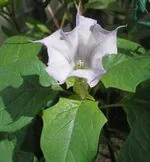
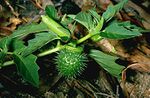
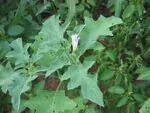
Due to its extensive cultivation and naturalization throughout the temperate and tropical regions, datura is found in most areas of the world. There are nine identified species:
Toxicity and harm potential
It is extremely important to note that a single dose of datura can be extremely unpredictable and has the potential to result in severe consequences, hospitalization or death. The toxicity and long-term health effects of regular datura usage do not seem to have been studied in any scientific context and the exact toxic dosage is unknown. This is because long-term datura usage is very rare and the vast majority of people who try this compound do not wish to repeat the experience.
In traditional cultures, a great deal of experience with and detailed knowledge of datura was critical to minimize harm.[4][5] Many fatal incidents result from modern users ingesting datura. For example, in the 1990s and 2000s the United States media contained stories of adolescents and young adults dying or becoming seriously ill from intentionally ingesting datura.[6][7] There are also several reports in the medical literature of deaths from D. stramonium and D. ferox intoxication.[8][9][10] Children are especially vulnerable to atropine poisoning and their prognosis is likely to be fatal.[11][12]
In some parts of Europe and India, datura has been a popular poison for suicide and murder. From 1950 to 1965, the State Chemical Laboratories in Agra, India investigated 2,778 deaths caused by ingesting datura.[13][14][15]
Psychosis
Datura has been reported to cause psychosis and delirium at a significantly higher rate than other hallucinogens like LSD, ketamine, or DMT. There are a large number of experience reports online which describe states of psychotic delirium, amnesia and other serious consequences after abusing the drug. In many cases, it has resulted in hospitalization and death.
It is strongly recommended that one avoid this compound altogether or at least uses extreme caution and harm reduction practices when using this drug, including having a sober trip sitter.
Lethal dosage
There can be a 5:1 potency variation between plants and a given plant's toxicity depends on its age, where it is growing, and the local weather conditions. This variation makes datura exceptionally hazardous as a drug and there is no way for the common man to accurately measure the dosage of any given plant. Datura has been used for centuries in some cultures as a poison because of the presence of these substances.[16][17]
The safest way to prevent overdose is to grind the dried plant matter into an extremely fine and even powder so that the active chemicals within them are distributed evenly across itself. From here, one can slowly work their way up in extremely small increments until the correct dose for that particular plant is found.
It is strongly recommended that one use harm reduction practices when using this drug.
Tolerance and addiction potential
The use of datura can be considered mildly addictive with a high potential for adverse side effects such as psychosis. In comparison to other hallucinogens, datura has been reported to be significantly less addictive than that of MXE, [[Ketamine], 2C-B and LSD. This is simply because the vast majority of people who try this compound do not wish to repeat the experience.
Tolerance to many of the effects of datura develops with repeated use. This results in users having to administer increasingly large doses to achieve the same effects. After that, it takes about 3 - 7 days for the tolerance to be reduced to half and 1 - 2 weeks to be back at baseline (in the absence of further consumption). Datura presents cross-tolerance with all deliriants, meaning that after the consumption of datura, all deliriantss will have a reduced effect.
Legal issues
Datura grows naturally and is legal to grow, sell and consume in most parts of the world. It is, however, restricted within the following countries:
- Australia: Datura is a Schedule I poison.
- Brazil: Possession and sale is illegal.
- United Kingdom - It is illegal to produce, supply, or import this drug under the Psychoactive Substance Act, which came into effect on May 26th, 2016.[18]
Experience reports
Anecdotal reports which describe this compound within our experience index include:
- Experience:450(Seeds)-Talking to Ghosts
- Experience:Datura Alcoholic Tincture
- Experience:Results of Experiment by Isopropanol
Additional experience reports can be found here:
See also
External links
References
- ↑ Atropine eye drops | http://www.netdoctor.co.uk/eyes/medicines/atropine-eye-drops.html
- ↑ http://books.google.co.uk/books?id=hw0DAAAAQAAJ&pg=PA792&lpg=PA792&dq=%22in+one,+producing+blindness+with+large+dilatation+of+the+pupil%22&hl=en#v=onepage&q&f=false
- ↑ Vice News - Colombian Devil's Breath | https://www.vice.com/en_ca/video/colombian-devil-s-breath-1-of-2
- ↑ Preissel, U.; Preissel, H.-G. (2002). Brugmansia and Datura: Angel's Trumpets and Thorn Apples. Buffalo, NY: Firefly Books. pp. 106–129. ISBN 1-55209-598-3.
- ↑ Spirit, Mind and Body in Chumash Healing (PubMed.gov / NCBI) | http://www.ncbi.nlm.nih.gov/pmc/articles/PMC1297503/
- ↑ Suspected Moonflower Intoxication --- Ohio, 2002 | http://www.cdc.gov/mmwr/preview/mmwrhtml/mm5233a2.htm
- ↑ Jimson weed users chase high all the way to hospital | http://usatoday30.usatoday.com/news/nation/2006-11-01-jimson_x.htm
- ↑ Discussion of "Datura stramonium: a fatal poisoning" (PubMed.gov / NCBI) | http://www.ncbi.nlm.nih.gov/pubmed/6502123
- ↑ Fatal poisoning from ingestion of Datura stramonium seeds (PubMed.gov / NCBI) | http://www.ncbi.nlm.nih.gov/pubmed/15080209
- ↑ Fatal Datura poisoning: identification of atropine and scopolamine by high performance liquid chromatography/photodiode array/mass spectrometry | http://www.fsijournal.org/article/S0379-0738(04)00171-9/abstract
- ↑ Datura intoxication in Riyadh (PubMed.gov / NCBI) | http://www.ncbi.nlm.nih.gov/pubmed/6710568
- ↑ Acute intoxication with "sobi-lobi" (Datura). Four cases in Niger (PubMed.gov / NCBI) | http://www.ncbi.nlm.nih.gov/pubmed/11204734
- ↑ Preissel, U.; Preissel, H.-G. (2002). Brugmansia and Datura: Angel's Trumpets and Thorn Apples. Buffalo, NY: Firefly Books. pp. 106–129. ISBN 1-55209-598-3.
- ↑ Spirit, Mind and Body in Chumash Healing (PubMed.gov / NCBI) | http://www.ncbi.nlm.nih.gov/pmc/articles/PMC1297503/
- ↑ Daturas | http://www.sleuthsayers.org/2012/02/daturas.html
- ↑ Preissel, U.; Preissel, H.-G. (2002). Brugmansia and Datura: Angel's Trumpets and Thorn Apples. Buffalo, NY: Firefly Books. pp. 106–129. ISBN 1-55209-598-3.
- ↑ Spirit, Mind and Body in Chumash Healing (PubMed.gov / NCBI) | http://www.ncbi.nlm.nih.gov/pmc/articles/PMC1297503/
- ↑ Psychoactive Substances Act 2016 (Legislation.gov.uk) | http://www.legislation.gov.uk/ukpga/2016/2/contents/enacted


.jpg/)
